Interacting with Miniature Railroading posted a link to this great one-hour long video of a railroad in Eritrea.

Eritrea: Rebirth of a Railway and Steam Trains

Play full size in new browser window

Volume 2

Joe Fugate was kind enough to send me a review set of his Siskiyou Line videos. The five volume set covers almost all aspects of the design, construction, and operation of his HO scale Siskiyou Line layout based on the Southern Pacific’s Siskiyou Line in the 1980’s.

Please see my comments on Volume 1 here.

Volume 2: Design and Construction is mainly a case study of how Joe’s layout design evolved and an outlune of construction techniques used. 
Starting with design and concept Joes walks us through each stage of the process beginning with the importance of finding a layout concept that really excites you. That excitement and engagement is really important since it is what will carry you through the work it takes to stick with the project.

Scenery

Joe goes through the role of a CAD system in designing a layout but his emphasis is on the design process, not on the mechanics of running a CAD program. I think this is a good point. WHAT you are drawing is much more important than how you go about making the lines on the paper.

Early in determining how he was going to use his available space Joe decided that some form of multi deck style layout was what he wanted since it would significantly increase the possible length of the mainline. Joe goes into excellent detail showing how a mushroom style multi deck configuration works and his approach to construction. I think this will be really helpful to people curious about whether this is an approach they want to tackle themselves.

Multi deck design

Joe demonstrates the process of creating a list of “Givens and Druthers” (In software projects I call these “Musts” and “Wants”) to help prioritize Layout Design Elements (explained below) that are contemplated for the layout. Additionally Joe shows how requirements for adequate aisle room, minimum curve radius, and room size and shape all interact in shaping the plan.

A Layout Design Element is a scene or other aspect that you really want reflected in your layout design. For example, Joe showed that one layout design element he wanted was the Roseburg yard; another was the bridge crossing the North Umpqua River. Looked at this way, track planning really becomes arranging desired layout design elements, adjusting their size and shape to fit the available space, and connecting with tracks.

This demonstrates for the viewer a very approachable technique to designing their own layout.

As Joe finishes his design discussion he emphasizes that a plan is only that. During construction, plans can change.

Joe’s discussion of benchwork construction very reasonably focuses only on those aspects that are unique because they are a direct result of his particular planning decisions. These particularly include details of how the mushroom aspects of the benchwork were constructed.
Joe gives a really interesting story about the trials-and-errors encountered in the design and implementation of the helix required to move trains between his lower and upper levels. This was really helpful to me in particular since it explains the trouble I’m having with my darn hill : From Joe’s disussion I see how I neglected to appreciate the required grade compensation caused by my tight 18” radius mainline curves adding effective grade to an already steep 4%+ grade. Argh for me – but also Ah ha! Now I have a better handle on how to fix the issue.

Joe details the very straightforward lighting system he uses on the layout and then moves into some straight How-To sections showing how he builds Masonite spline roadbed. Another how-to is on flextrack laying techniques.
Finally, included on the disk as Special Features are quick notes on how to add power routing and handling complex installation with his Easy Throw switch controls as well as a Power Point style presentation of metrics you can use to numerically measure and compare different tack plans.

Overall, I think the most interesting and useful thing found in this video is the problem solving process Joe demonstrates since this is where I really felt I was learning and gaining experiences that would help improve my own design and construction work. Although Joe flags this video as Intermediate/Advanced I think beginners will see how to avoid common mistakes and also learn from Joe’s experiences that mistakes can and will be encountered but can also be overcome.

I think viewers will get the most value from this video if they have seen Volume 1 first.

Joe’s DVDs may be purchased at model-trains-video  and retail for $24.95 each.

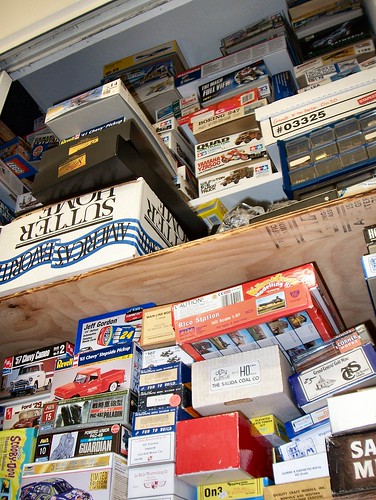
barn full of boxes

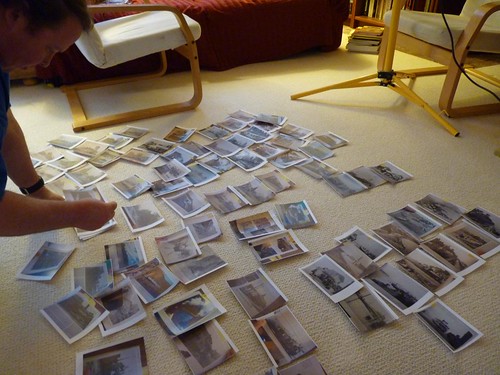
This long July 4th weekend has been mainly devoted to getting the whole dang house out of boxes. Fortunately we’re moving from a 1300 square foot condo apartment into a significantly larger house with a workshop/studio outbuilding in the back. Moving from smaller to bigger is almost always the happier direction.

My wife and I have a lot of books and I have my over 40 years of Model Railroader back issues (and all the Narrow Gauge & Shortline Gazettes, and a bunch of other modeling magazines…). Incredibly the previous owner had the garage turned into an office/library with a loft full of bookcases.

upper deck of library

If the place had a 2000 sq. foot full basement with no obstructions it might be more perfect but this is northern California and full basements are not typically found until you go several states over.

In the mean time, I must get these boxes unpacked so I can use that studio!

barn full of boxes

Wish me luck! My son got lost somewhere back there this morning.

barn full of boxes

Volume 1

Joe Fugate was kind enough to send me a review set of his Siskiyou Line videos. The five volume set covers almost all aspects of the design, construction, and operation of his HO scale Siskiyou Line layout based on the Southern Pacific’s Siskiyou Line in the 1980’s. I tripped across Joe’s website several years ago and was struck by the excellent scenery (especially the trees and ground cover) so I was really pleased to have a chance to see the videos he has made.

Volume 1: Modeling a prototype is a really nice overview and I found it reminded me favorably of Allen Keller’s Great Model Railroads series in overall format. The DVD starts with a rail-fan style trip following trains around the 800 square foot layout. We then meet Joe as he describes the creative process he followed to end up with his layout’s concept. One twist is that he maintains a strict 20 year date offset so if it’s July 4, 2008, then it is July 4, 1988 on his layout. Next we see how the layout’s mushroom configuration and clever construction plan allows a functionally 1200 square foot layout to fit into his 800 sq. foot space.

Vol1 still 1

After that Joe takes us section by section through the layout describing how each relates to the prototype and features of operational interest he’s implemented. Next we follow the Coos Bay Hauler along its route as Joe demonstrates the dispatching and schedule system he uses. I’m a small line steam guy and plan on strenuously avoiding most operational paperwork but Joe shows that attention to this detail can help you feel immersed in running the train over the branch.

I have say it: I found a continuity error. Joe carefully demonstrates how he realistically includes adding and dropping water cars (cars which drop water to help prevent fires) from the train but immediately after dropping the two black water tank cars the train pulls out and the siding where the tank cars were spotted (indicated by the red arrow below) – is mysteriously empty.

Vol1 still 2

The video closes with a straight how-to showing how Joe uses ordinary brass door bolts to manually actuate his turnouts.

Production quality is good. I viewed this video on a 46″ HD TV and it looked good and sounded great.  Joe is an excellent narrator and my son and I both really enjoyed watching the video. Joe did an excellent job introducing and orienting us to the layout and I’m looking forward to seeing how he builds his excellent scenery and track work.

Minor nit picks: Joe’s lighting is a bit too shadow-free and could have used key lighting. Admittedly, this is tough to do on many layouts. The editing pace is a tad slow.

I think Volume 1 is free-standing in the sense that it is a good value all by itself without the rest of the series. However, I’ve already gone on to Volume 2 (full review later) and can report it presents a wealth of new material and is a great follow-on to Volume 1.

Joe’s DVDs may be purchased at model-trains-video and retail for $24.95 each.

Phew. Moving our thousands of books is a real workout. We’re “only” moving about one mile away (four road miles) so I got it into my pea brain that we should do most of the moving ourselves. Yeah. Yeah. Yeah. I hear you. Next time I’ll pay someone else to do it.

I am actually enjoying going through all my modeling material I’ve been squirreling away for “some day” and I’m really feeling like some day is becoming Today. I have over 300 un-built model kits. Gulp. Time to get cracking.

Picture 001

The good news: My San Juan Central (aka Northwestern Pacific) was indeed portable!

The good news is that my big project at work – DARPA RealWorld successfully hit its two-year midpoint milestone. RealWorld is a $40 million, 4-year project to build a framework to allow war fighters the capability to rapidly create mission rehearsal “games” leveraging commercial computer game technology. My company, Total Immersion, is under contract to DARPA to build RealWorld. The bad news has been that I’ve been so slammed working on it that all modeling work ground to a halt.

More bad news is that I’m moving next month which pushes out resuming model work a bit more.

The good news is that I’m moving to a bigger place with a large external building I can use for a shop/modeling studio! I’m really excited about it.

Now I get to see how “portable” my San Juan Central really is.

IHC 4-4-0 as NWP 8

I’ve always loved NWP number 8 as shown in this 1915 view below.

NWP 8

I’d like to try to use this IHC 4-4-0 Old Time American as a starting point to model NWP 8.

IHC N.Y.N.H. & H 4-4-0

These models have been around since the 1970’s and have tender drive. They’ve been sold under several names (IHC, Rivarossi, AHM, and Pocher). They are not really HO scale (3.5 mm = 1 foot) but rather are OO scale (4.0 mm = 1 foot, running on HO track). So why use them? I bought 3 on sale for around $30 each and I used to have one when I was a kid so I’m interested in seeing how good a model I can make based on this chassis.

This particular model has an updated pilot with a knuckle coupler (a dummy as shipped) and a straight, albeit not plain, stack.

I’ll start with a design sketch to get an idea what the model would look like. I took the photo of the stock engine above and placed it on a lighted tracing table.

Picture 007

Then I taped a sheet of paper on this and traced out the engine. The cab, headlight, and tender are embellished with the changes needed to bring the appearance closer to NWP 8.

Picture 006

Note that I copied the model, warts and all. This will be a drawing of the model based on an IHC chassis, not a drawing of a real engine.

Picture 005

As I sketched in changes I referred to my picture of NWP 8.

The proposed cab will be larger, metal, and pushed forward a bit. I also drew in an air compressor interrupting the walkway, a generator in front of the steam dome, and engine brakes between the drivers.

Picture 003

The most significant change I’m planning is to lower the forward frame. As a digital drawing it was trivial to cut and paste the frame about a scale foot lower. The final drawing shows that these changes will yield an attractive engine.

IHC 4-4-0 as NWP 8

Small, nimble on the rails and with beautiful proportions, the classic 4-4-0 “American” has always been one of my favorite engine types. As I mentioned in my last post, the Northwestern Pacific Railroad was powered almost exclusively by small 4-4-0 and 4-6-0 engines. This is one of the great things about modeling the NWP on the limited size of a model railroad since small engines help create the illusion of greater layout size and mainline distance.

Exact RTR (ready-to-run) models of NWP engines are not available. Consistent with my overall modeling philosophy (plausible but free-lanced), I’m going to examine the engines of the NWP and build engines for my layout that are consistent with the spirit of the prototype. My goal is to build plausible and reasonable, while not exact, models. Understanding the prototype well enough to build things and make decisions consistent with the way the builders and mechanics of the NWP did things is what I enjoy.

The Americans on the NWP in the 1920s fell into two broad groups: old engines built in the 1870s and 1880s — some twelve engines and a “new” group of seven built between 1904 and 1914.

The Old Engines

By the 20s, the older 4-4-0s had been in service between 40 and 50 years and had been significantly updated and altered from their as-built appearance. As built the engines would have looked much like these shown below:

Grant 4-4-0 1873 Grant 4-4-0 1873

Baldwin 4-4-0 1871 Baldwin 4-4-0 1871

Both of these engines are standard “catalog” offerings and are therefore typical engines. Compared to the mechanical standards of the 1920s these engines are missing many pieces of equipment:

1920-29 Standard Equipment:

  • Engine brakes
  • Knuckle couplers
  • Air pumps and associated hardware
  • Electric lights, generators and associated equipment
  • Oil burning modifications (in the NWP case)

While engines may have left the factory looking pretty similar, railroads would generally shop engines only when something broke or needed to be done to meet new requirements (compatible couplers, air brakes, etc.). Individual engines in their 50 year trek to their 1920 appearance would have been shopped and upgraded on unique schedules. In this way each of the old Americans on the NWP looked quite different from each other by the 20s.

NWP 8 Engine 8 was an 1881 Baldwin product with 63” drivers, 15×24 cylinders and weighed 71,000 lbs. By 1915 it looked like this:

NWP 8

Engine 8 has received minimal modification beyond the standard equipment listed above, a new metal cab, and a new pilot. This is probably not what the engine looked like by the 1920s but I love the proportions of this engine and will likely model it as seen above.

NWP 9 An 1883 Grant product, number 9 had 59” drivers, 16×24 cylinders and an 86,300 lb. engine weight. Number 9 was heavily modified in its lifetime and in the 1920s probably looked something like this 1935 view.

NWP 9

Engine 9 has an entirely new boiler and obviously mismatched pilot truck wheels.

Transition between the Old and New 4-4-0s

Boiler location: In the 20th century as scientific principals were increasingly applied to locomotive engineering, an emphasis grew on firebox design, boiler pressure and superheating. For the classic 4-4-0 (shown in cutaway below) the location of the firebox low between the engine frames severely limited the size of the grate and therefore the amount of boiler horsepower that could be generated.

Baldwin 4-4-0 1871 cutaway

The solution was to raise the boiler centerline so that the bottom of the firebox was completely above the engine side frames. As early as the 1888 view shown below this techniques came into use. However, while wider than before the firebox is still constrained to fit between the driving wheels.

PRR 4-4-0 1888 noted

One of the ultimate limitations on the 4-4-0 design is that increasing the firebox size further was never seen as practical. On more modern engines with different wheel arrangements the boiler was raised even higher so that the firebox and grate could be carried completely above the driving wheels and widened to the width of the engine. NWP 4-6-0 number 181 below shows this kind of configuration.

NWP 181

Extended firebox: Comparing the Baldwin 1871 with the PRR 1888 drawing also note the difference in how far the smoke box (the part of the boiler the smokestack is mounted on) extends forward. To hopefully enhance complete combustion, the “extended” smoke box became common (but not universal) on new and rebuilt engines.

Superheating: Superheaters were added to locomotives by changing the boiler design such that steam lines were fed back into widened fire-tubes in the boiler increasing the temperature of the steam and thereby increasing the amount of work the steam could do. This reduced fuel and water consumption for a given amount of power produced. On an old engine superheating is typically only signified by the change from slide valves to piston valves .

Variously updated 4-4-0s on the NWP in the 1920s

This is not a complete breakdown and I picked the following engines because I find them the most interesting.

NWP 10 was a twin sister engine to number 9 (Grant numbers 1665, 1664, respectively) but by 1920 appeared highly modified and updated.

NWP 10

Fully updated with all the modern (1920s) conveniences. Slide valves (superheated), new boiler, air and electrical equipment.

NWP 17 was a Rogers 1889 product with 63” drivers, 17×24 cylinders, and 87,300 lb. engine weight.

NWP 17

In this 1927 view the engine appears to still have its original boiler since the steam dome is old-style location directly over the firebox and the smoke box is not extended forward. The engine has air and electrical equipment.

NWP 20 was a Rogers 1884 product (older than 17 above) with 62” drivers, 18×24 cylinders and 93,800 lb. weight.

NWP 20

In this 1923 photo the fluted domes on number 20 might lead you to think that this is the original boiler. However, my best guess is that the boiler was added around 1917 and the old domes were apparently reused.

NWP 21 was a Baldwin 1904 product with 69” drivers, 18×24 cylinders, and 117,350 lb. weight.

NWP 21

What a difference a few years makes! Number 21 is much heavier than the older engines and in this 1936 photo looks quite modern with the exception of the slide valves.

NWP 22 was a 1908 American product with 69” drivers, 18×24 cylinders, and 128,500 lb. engine weight.

NWP 22

Fairly modern engines but still with slide valves in this 1931 view so presumably not superheated.

NWP 52 was one of the last batch of 4-4-0s purchased by the NWP in 1914. These had 63” drivers, 19×26 cylinders and a hefty 158,500 lb. engine weight.

NWP 52a

These engines were more than twice the weight of old number 8. Note the modern piston valves and Walschaerts valve gear.

Southern Pacific 4-4-0s

For comparison and more modeling ideas I have some photos of 4-4-0s from the Southern Pacific since SP was one of the NWPs corporate parents and some mechanical influences are evident.

sp1421 in 1924

SP 1421 is shown in 1924. The thing I like is the headlight moved to the center of the smoke box front per SP practice.

sp1358 in 1923

SP 1358 is shown in 1923 and other than air and electrical is looking pretty old fashioned indeed. The relatively un-altered appearance of this engine is my justification for carrying forward NWP 8’s ultra-cute 1915 appearance forward to the 20’s.

Next Page »